Using GCSE Specifications, Past Papers and Mark Schemes Effectively
The following provides students, parents and carers with direct access to GCSE specifications, past papers and mark schemes for each subject studied at Heathland School. The specification should be used as a revision checklist, helping students identify exactly what knowledge and skills can be assessed in each examination.
|
Subject |
Examination Board |
Specification |
Past Papers and Mark Schemes |
|
GCSE Combined Science |
OCR Gateway A |
GCSE Combined Science Past Papers and Mark Schemes
You will need to choose either Higher Tier or Foundation Tier Papers |
|
|
GCSE Computer Science |
OCR |
|
GCSE Computer Science Past Papers and Mark Schemes
|
|
GCSE Design & Technology |
AQA |
GCSE Design and Technology Past Papers and Mark Schemes
|
|
|
GCSE Drama |
AQA |
|
GCSE Drama Past Papers and Mark Schemes
|
|
GCSE English Language |
AQA |
GCSE English Language Past Papers and Mark Schemes
|
|
|
GCSE English Literature |
AQA |
GCSE English Literature Past Papers and Mark Schemes
|
|
|
GCSE French |
AQA |
GCSE French Past Papers and Mark Schemes You will need to choose either Higher Tier or Foundation Tier Papers |
|
|
GCSE Food Preparation & Nutrition |
AQA |
GCSE Food Preparation & Nutrition Past Papers and Mark Schemes |
|
|
GCSE Geography |
Edexcel B |
||
|
GCSE History |
Edexcel |
GCSE History Past Papers and Mark Schemes
Option 10: Crime and punishment in Britain
Option P4 Superpower relations and the Cold War,1941–91
Paper 3: Modern depth study
Option 31: Weimar and Nazi Germany, 1918–39
B4: Early Elizabethan England, 1558–88
Students need to select the papers/options corresponding to the History topics they have studied.
|
|
|
GCSE Mathematics |
Edexcel |
GCSE Mathematics Past Papers and Mark Schemes
You will need to choose either Higher Tier or Foundation Tier Papers
|
|
|
GCSE Music |
Eduqas |
||
|
GCSE Religious Studies |
Edexcel B |
||
|
GCSE Separate Sciences (Biology, Chemistry, Physics) |
OCR Gateway A |
GCSE Separate Sciences Biology
GCSE Separate Sciences Chemistry
|
GCSE Biology Past Papers and Mark Schemes
GCSE Chemistry Past Papers and Mark Schemes
GCSE Physics Past Papers and Mark Schemes
You will need to choose either Higher Tier or Foundation Tier Papers |
|
GCSE Spanish |
AQA |
GCSE Spanish Past Papers and Mark Schemes You will need to choose either Higher Tier or Foundation Tier Papers |
|
|
GCSE Theory of PE |
AQA |
GCSE Physical Education Past Papers and Mark Schemes
|

Past papers are one of the most effective revision tools available. They help students become familiar with examination expectations, improve time management, identify knowledge gaps, develop examination technique and build confidence when answering GCSE-style questions. Students are encouraged to complete questions and papers under timed conditions wherever possible.
Full Paper Timing Checklist
When completing a full examination paper, students should:
- Check the total number of marks available.
- Use the 1 mark ≈ 1-minute rule (unless advised otherwise by your teacher or examination board).
- Divide your time according to the marks available for each question.
- Keep a clock or timer visible throughout the paper.
- Move on if you are spending too long on a question and return to it later if time allows.
- Leave 5-10 minutes at the end to check answers, correct mistakes and complete any unfinished responses.
- Record your score after marking and identify topics requiring further revision.
Example: A 90-mark paper should take approximately 90 minutes. A 5-mark question should take around 5 minutes, whilst a 15-mark question should take around 15 minutes.
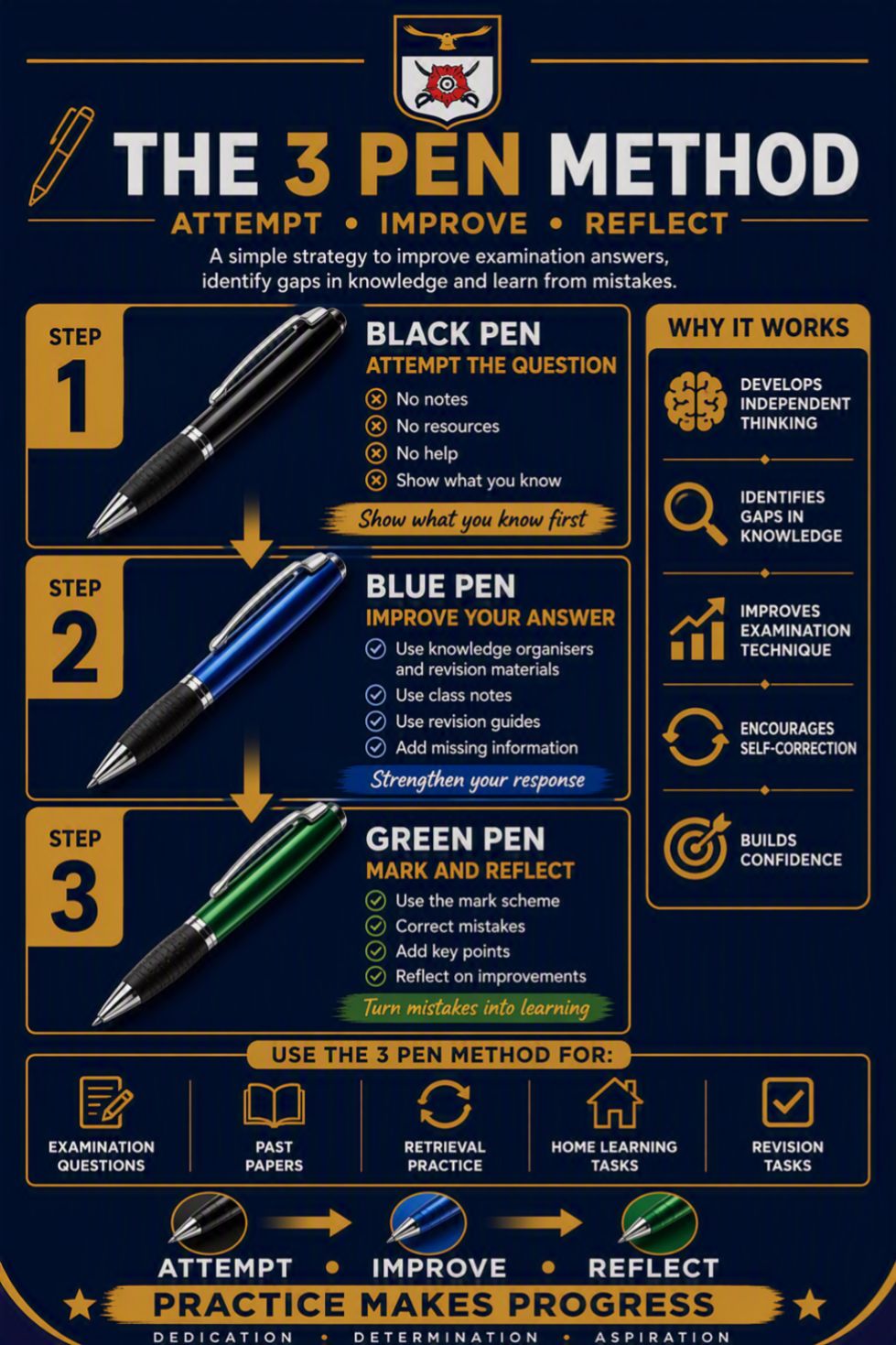
Use the 3-Pen Method
To maximise the benefits of past papers, students are encouraged to use the 3-Pen Method:
Other Effective Ways to Use Past Papers
- Annotate command words and key terminology before answering questions.
- Complete individual questions by topic before attempting full examination papers.
- Use mark schemes to understand how marks are awarded and what examiners are looking for.
- Review model answers and examiner reports.
- Create revision flashcards based on mistakes or gaps in knowledge.
- Complete exam questions with a study partner and discuss different approaches.
- Revisit questions several weeks later to test long-term retention and measure progress.
- Track scores over time to identify strengths, priorities and areas requiring further revision.
Benefits of Using Past Papers
Regular use of specifications, past papers and mark schemes can help students:
- Improve recall and long-term retention of knowledge.
- Develop confidence in examination conditions.
- Strengthen time management skills.
- Understand the examiner's expectations.
- Refine examination technique.
- Identify and address misconceptions.
- Secure marginal gains that can make a significant difference to final grades.
Remember: The most successful students do not simply complete past papers; they review, reflect and improve their responses. Consistently applying feedback and using the 3-Pen Method will help students make the greatest progress and achieve their full potential.